
AI Can Write the Note. It Can't Have the Conversation.
By: Based on a presentation by Hélène Thériault, BScOT, MAdEd, MCC
By: Based on a presentation by Hélène Thériault, BScOT, MAdEd, MCC
Artificial Intelligence in Your Clinic
Artificial Intelligence (AI) is moving into clinical practice quickly. It drafts notes, suggests home programs, and answers patients' questions at 2 a.m. For many of us, that's genuinely good news. Less time on documentation means more time with the person in front of us.
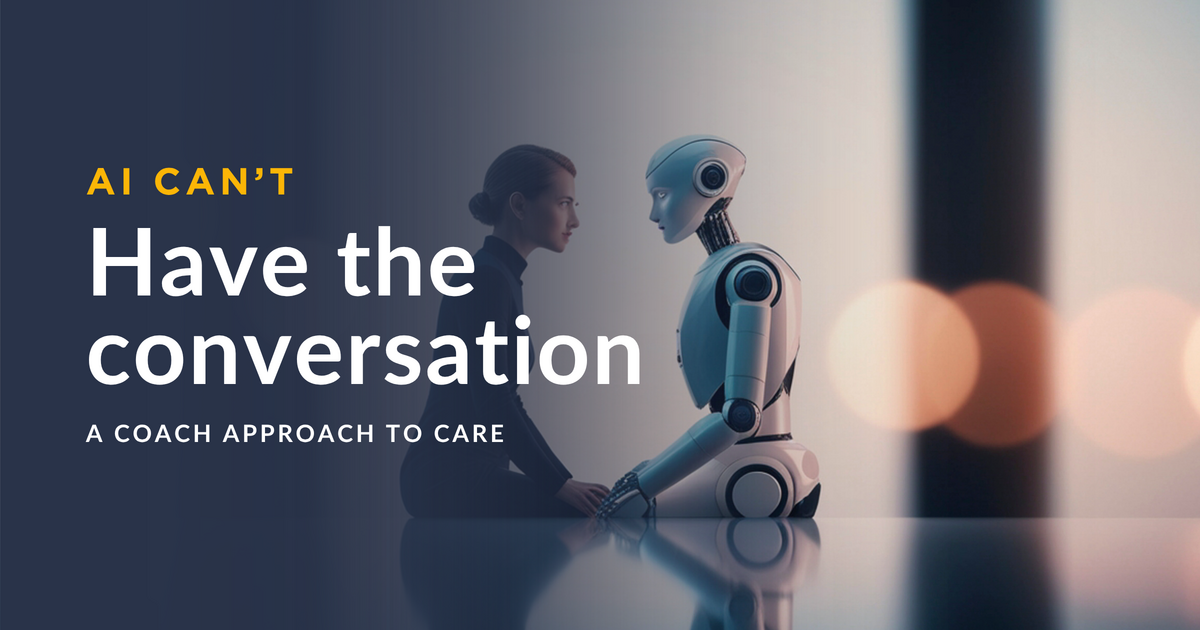
But there's one part of care AI can't take over: the conversation that turns a plan into something a patient actually does.
Your patient can ask a chatbot about their condition, their exercises, or the research behind their treatment. What they can't get from it is the experience of being heard by a clinician who helps them work out what matters to them, what's gotten in the way before, and what they're ready to try this week. That's where follow-through is built. And as AI takes on more of the information work, that human skill becomes more valuable, not less.
We made this case in a free 90-minute webinar, including a live coaching demonstration and debrief. Watch the free recording on Embodia →
Information Isn't the Same as Follow-Through
Most of us were trained to educate. We assess, explain, prescribe, and repeat. When a patient doesn't follow the plan, our instinct is to explain it again, more clearly this time.
Yet many patients already know what they "should" do. They've heard it from us, from their physician, and from the internet. The gap isn't information. It's emotion, belief, motivation, assumptions, and everything else that shapes whether someone acts on what they know.
That's the gap a coach approach used in healthcare is designed to close.
What a Coach Approach is, and What it Isn't
Hélène defines coaching in healthcare as a semi-structured conversational partnership. You and your patient co-develop concrete action plans by drawing on the patient's own strengths, resources, and creativity. The goal is to help them meet the needs that matter to them and create sustained change through self-directed action.
In practice, that looks like a few shifts:
-
From backward-looking to forward-looking. Less time rehashing what went wrong, more time on what comes next.
-
From expert-led to equal partnership. You still bring your clinical expertise, but the patient helps set the direction.
-
From authoritative to inquisitive. Questions do more of the work than instructions.
-
From problem-oriented to strength-oriented. You build on what has already worked for them.
-
From "see you next week" to a clear action plan. The patient leaves with a next step they chose and own.
The difference often comes down to a single question. Compare "You need to do your exercises every day" with "What helped you stick with it the last time things went well?" The second question invites the patient to find their own answer, and people are far more likely to act on answers they've found themselves.
It Fits in the Time you Already Have
The most common objection we hear is time: "I have 30 minutes, and half of that is treatment."
A coach approach isn't an extra hour-long session added to your caseload. Hélène's Coaching Spectrum Framework™ shows how coaching can show up in four ways:
-
In the moment, as a single well-placed question.
-
As laser-focused coaching.
-
Blended into therapy.
-
As extended coaching sessions when the setting allows.
Most practitioners start at the lighter end of the spectrum. With structure and practice, meaningful coaching conversations fit in 10 to 15 minutes, whether you're in the clinic, on a telehealth call, or leading a team.
Where AI Fits
We're not asking you to choose between AI and human connection. The more useful question is where each belongs.
Let AI handle what it does well: drafting, summarizing, organizing, and reminding. Then protect the conversation for what only you can do. That means listening for what your patient isn't saying, noticing the shift in their voice when they talk about their grandkids, and helping them turn that motivation into a plan.
AI can work around the conversation. It shouldn't replace it.
This Matters For You, Too
A coach approach isn't only about patient outcomes. It changes how the work feels.
Hélène created Dive Into a Coach Approach® (DICA) after experiencing burnout that nearly led her to leave occupational therapy. She realized the missing piece wasn't more clinical expertise. It was learning to stop carrying the full weight of "fixing" and to start facilitating conversations that helped people uncover their own motivation and next steps.
When patients take more ownership, you carry less.
Try One Small Experiment this Week
Before your next session, pick one moment where you'd normally explain or instruct. Instead, pause and ask a question. Then give your patient space to find their own next step.
Notice what happens, both for them and for you. If you want to see what this looks like in a real exchange first, the coaching demonstration in the free recording, What AI Can't Do: The Case for Coaching in Healthcare, is a good place to start.
Keep Building the Skill With Us
Start free. Watch What AI Can't Do: The Case for Coaching in Healthcare on Embodia. It includes the workbook, the full presentation, and a certificate of completion.
Go deeper. If you want structure, practice, and feedback as you bring this into your work, join our six-month live cohort, Staying Human in an AI-Assisted Practice: Building a Patient Follow-Through Playbook.
What's included:
-
Live sessions: 12 sessions of 90 minutes each on Wednesdays, 6:00 to 7:30 p.m. ET, from October 14, 2026, to March 2027, plus a check-in session on April 14, 2027. All sessions are recorded, and you keep access for one year.
-
Office hours: monthly drop-ins with Hélène from November 2026 to March 2027
-
Practice and community: partner practice, a cohort forum on Embodia, an 80+ page workbook, and graduate resources you keep.
-
Topics: the DIVE IN Goals™ framework, powerful questions, laser-focused coaching, telehealth and remote monitoring, and using AI tools around the conversation. A guest session on billing, coding, and documentation for coaching is led by Jennifer Lundman.
-
Certificate: the Coach Approach in Healthcare Professional Certificate and digital badge.
-
Continuing education: 20 ICF CCE hours, 2.0 AOTA CEUs (20 learning hours), and 19 NBHWC CE hours, as well as by the Alberta Kinesiology Association
The cohort is built for allied health professionals, including physical therapists and physiotherapists, occupational therapists, speech-language pathologists, kinesiologists, nurses, and practice owners who are both clinicians and leaders.
Registration: CAD $999. Registration is capped at 50 participants and closes October 14, 2026, at 5:59 p.m. ET.
Bring a colleague: if you register with a partner, you each save 25%. Email both names and email addresses to support@embodiaapp.com and we'll send you a unique code. No partner yet? We'll match you with someone in your time zone.
Explore the cohort and register →

MPT, BS, CLT, Coach Approach in Healthcare Integration Certificate
Physical Therapist | Coach Approach in Healthcare Integration Certificate | Oncology Rehabilitation Specialist | Certified Lymphedema Therapist | ADHD-Rehabilitation Service Provider
Tamara Shih holds a Master’s degree in Physical Therapy (MPT) and a Bachelor of Health Science with a minor in Biology. Her dedication to professional excellence is reflected in her extensive certifications, including being a Certified PORi Oncology Rehabilitation Clinical Specialist, Certified Fall Prevention Specialist, Certified in Manual Lymphatic Drainage, American Institute of Balance Vestibular Rehabilitation/Concussion Certified, a Certified Lymphedema Therapist, ADHD-Rehabilitation Service Provider, and an APPI Certified Pilates Instructor.

MAdEd, BScOT, Master Certified Coach (MCC)
With over two decades of experience in the medical field, Hélène Thériault is a globally recognized speaker, Master Certified Coach (MCC) accredited by the International Coaching Federation (ICF), and award-winning educator. Renowned for her expertise in healthcare and adult education, she is also a clinical instructor at the University of British Columbia.
Hélène holds a Master of Adult Education degree from St. Francis Xavier University and is the founder of Function First Coaching Inc, where she specializes in certifying healthcare professionals, including physiotherapists, in using her evidence-based, holistic coaching framework. Her innovative approach combines advanced coaching techniques, leadership development, strength-based models, and customized tools to empower professionals, grow businesses, and achieve lasting results for clients.
Fluent in both French and English, Hélène is passionate about transforming healthcare through coaching, equipping practitioners with the skills to lead with confidence and foster meaningful, patient-centred outcomes.